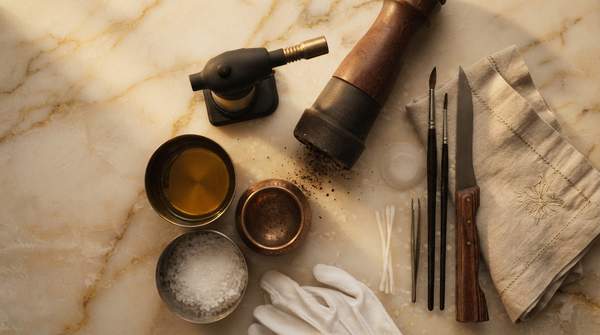
The difference between a snapshot and a shot that makes people hungry usually comes down to tiny, deliberate adjustments — and those adjustments demand the right small tools. Working food photographers consistently rely on a compact kit of hand-held instruments to solve five recurring on-set problems: placing details precisely, moving delicate items without damage, cleaning and glistening surfaces, faking freshness, and keeping unstable props still. Here is how each tool earns its place, and which one to reach for when a specific problem appears in your viewfinder.
Food Styling Toolkit: Functions and Advantages
The table below maps each tool to the styling problem it solves, so you can prioritize purchases against the challenges you actually face. If you shoot garnished desserts and salads, start with tweezers; if condensation and glisten dominate your work, the glycerin mix comes first.
| Tool | Primary Styling Task | Key Advantage |
|---|---|---|
| Precision tweezers | Placing small garnishes exactly, or removing unwanted specks and stray items | Meticulous adjustments without disturbing the surrounding food |
| Small offset spatula | Moving delicate items, like a cake slice, in controlled increments | Angled blade keeps hands clear and reaches tricky spots |
| Fine-tipped paint brushes | Brushing away crumbs and removing small unwanted elements | Fine control for detailed cleaning and surface work |
| Glycerin and water spray | Creating long-lasting droplets and a fresh, appetizing look | Droplets resist the rapid evaporation of plain water |
| Museum putty | Securing unstable or round items so they hold position | Keeps props from rolling or shifting mid-shoot |
Precision Tweezers: For Fine-Tuning Details
Food photographer Joanie Simon, who has documented her favorite styling tools, describes tweezers as the instrument for exactly the kind of micro-adjustment that separates amateur plates from styled ones. Her examples are concrete: precisely moving a piece of mint garnishing a dessert, or removing an errant tomato from a wedge salad. The same tool handled a sandwich shoot where a sausage had to be repositioned to get a proper sausage-to-pepper-to-onion ratio.
Not just any tweezers will do. Simon prefers the longer style used by professional restaurant chefs over the short tweezers from the drugstore beauty aisle, because the extra length gives you reach when you need to fish something out of an awkward spot on set. That reach matters more than it sounds: leaning over a styled scene with short tools risks bumping everything you just arranged. The core value is surgical control — you nudge one element without disturbing anything around it.
Small Offset Spatula: Mastering Delicate Movements
If you bake, you may already own this one: offset spatulas are the standard tool for frosting baked goods, and Simon notes they serve that same purpose on photoshoots — plus a second job that matters even more to photographers. They are helpful for moving things around a scene with control. Her go-to is a small four-inch version, precisely because it fits into tricky-to-reach places a larger blade can't.
The problem it solves is the repositioning dilemma. You've built the scene, the light is set, and then you realize the cake slice needs to move a quarter inch to the left. Fingers would smudge the frosting and knock neighboring props; a flat tool offers no leverage. The offset blade's angle keeps your hand up and away from the food while giving you the mechanical advantage to slide the slice cleanly. For anyone shooting baked goods regularly, this is arguably the first tool to buy, since it doubles as its everyday kitchen counterpart.
Fine-Tipped Paint Brushes: Cleaning, Glazing, and Coloring
Brushes are the quiet workhorses of the styling kit. Their documented strength is removal: brushing away crumbs and clearing small unwanted elements from a plate without disturbing the composition around them. A crumb on a dark sauce or a fleck on a pale surface reads as clutter at photo scale, and a fine tip lets you eliminate it surgically rather than rebuilding the plate.
Food photography educator Regan Baroni frames the underlying pressure that makes these tools necessary: food is incredibly time sensitive and starts to look bad when it sits too long, so you want to capture it looking fresh and beautiful. Fast, precise cleanup is part of that race against the clock. A set of inexpensive fine-tipped brushes — kept strictly for styling, never for paint — gives you the control to handle small elements and liquids without dripping or smearing. Keep several on hand so you can move between wet and dry tasks without cross-contaminating surfaces.
Glycerin & Water Spray: Creating Lasting Freshness
Plain water evaporates too fast under studio conditions, and that is the specific problem glycerin solves. Baroni calls glycerin essential on a food photography shoot, used to give ingredients or glassware a spritz that makes them look fresh and more appetizing — and she prefers a glycerin-and-water mixture over water alone. Photography educator Gary Martin gives the working recipe: mix glycerin in a 50/50 proportion with water and pour it into spritzers. That ratio is common practice cited across multiple food photography resources rather than a universal standard, so treat it as a reliable starting point you can adjust.
The payoff is staying power. Because the mixture resists the rapid evaporation that plagues plain water, your droplets hold through setup, lighting tweaks, and multiple frames. A food photography guide from Phoode notes glycerin is inexpensive and widely available, from local apothecaries to online retailers, and that a little goes a long way. Martin adds that glycerin itself costs a couple of dollars in most drugstores' beauty sections. For cold-looking beverages, glistening produce, or anything that needs to read as just-washed, this is the tool.
Assembling Your Essential Food Styling Toolkit
Prioritize acquiring precision tweezers, a small offset spatula, fine-tipped paint brushes, glycerin and water spray, and museum putty to address common food styling challenges and significantly enhance food photography. This is a starter set for general work — specialized subjects like ice cream or beverages can demand their own kits, and it covers only hand-held styling tools, not cameras, lenses, or lighting. The measurable indicator of success is improved precision in food arrangement and presentation, leading to more appealing and professional-looking food photographs. Watch for it in your own results: garnishes landing exactly where you intend, cake slices moved without smudges, crumbs gone, droplets that survive the whole shoot, and props that stay put frame after frame.
Sources
- 14 Favorite Food Styling Tools — The Bite Shot
- Best Food Photography Styling Tools — Regan Baroni
- Food Styling Glycerine Solution for Glistening Food Photography — Creative Food Photography Blog
- 12 Items You Need In Your Food Styling Kit and How to Use Them — PRO EDU