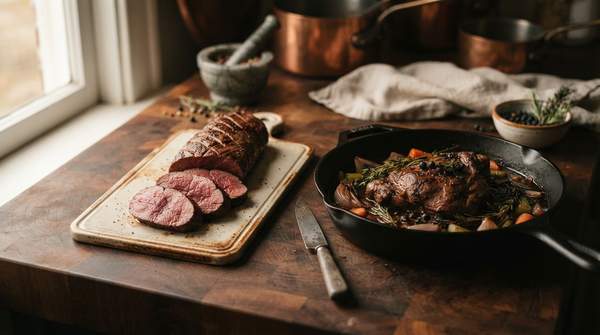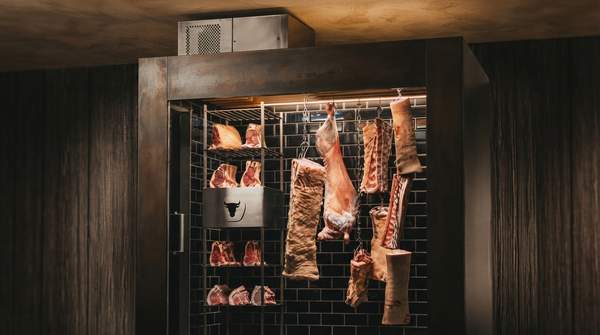
When I sear a dry-aged steak, I'm not just cooking—I'm setting off a chemical event that the aging process spent weeks preparing. Dry-aging does two things to the surface of the meat: it strips away moisture and it concentrates the very molecules the Maillard reaction feeds on. Those are exactly the two conditions—dryness and heat—that govern how fast and how intensely browning happens. That is why a dry-aged steak builds a deep, mahogany crust and a more complex savory flavor faster than a fresh or wet-aged one.
The Maillard Reaction: A Foundation of Flavor
Named for the French physician and chemist Camille Maillard, who first described it in 1912, the Maillard reaction is what happens when amino acids and certain simple sugars meet under heat. As NC State's College of Agriculture and Life Sciences explains, the reaction rearranges these molecules into rings and collections of rings that reflect light brown, while generating the aroma, flavor, and appearance we recognize as grilled or seared meat. It is not the same as caramelization, which involves sugars alone; the Maillard reaction requires nitrogen from proteins.
What makes it so powerful for cooks is its sensitivity. A scientific review of the reaction notes that its rate increases with temperature until a maximum rate is reached—a peak that varies depending on the food matrix, the reactants present, and the specific conditions. In meat, the key reactants are well documented: researchers writing on meat flavor models describe flavor precursors as non-volatile, water-soluble components—amino acids, peptides, reducing sugars, and thiamine—alongside lipid components. Amino acids and peptides, they note, are largely responsible for meat flavor, and the relative amounts of each precursor critically shape how flavor develops.
How Dry-Aging Primes Meat for Superior Searing
Here is the connection that most explanations miss. The Maillard reaction has two masters: dryness and temperature. Modernist Cuisine identifies these as "the key controls for the rate of the Maillard reaction," and the reason is physical as much as chemical. As long as a food's surface is very wet, its temperature cannot climb above the boiling point of water at atmospheric pressure—no matter how hot the pan. Only high-heat cooking can dry the surface enough to push the temperature into the range where browning proceeds rapidly.
Dry-aging does that drying work in advance, slowly, over weeks. As moisture evaporates from the meat's surface, the water activity drops and the remaining reactants—those amino acids, peptides, and reducing sugars—become more concentrated in the drier outer layer. The same review of meat flavor chemistry observes that aging processes promote the Maillard reaction by increasing the availability of precursors like amino acids and peptides. So when the steak finally hits the pan, it isn't starting from scratch: it arrives with a surface already low in moisture and already rich in reactive molecules.