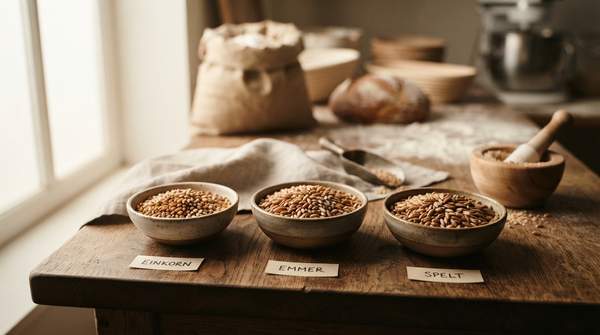
Spelt is the closest of the three to modern bread wheat and the most forgiving; emmer sits in the middle with moderate gluten and a rich, earthy flavor; einkorn is the most delicate, with the weakest gluten of the group and a taste that rewards tender, low-profile bakes. That ranking is not folklore—it shows up in the grains' protein chemistry. A comparative study of ancient and modern wheat species found that the key protein parameters behind baking quality are a high glutenin content and a relatively low gliadin-to-glutenin ratio, and einkorn and emmer fall on the weak end of that spectrum. All three still contain gluten, so none of them is an option for anyone with celiac disease.
Understanding Heirloom Grains: Einkorn, Emmer, and Spelt
Heirloom wheats are the older species that modern bread wheat displaced. Einkorn was cultivated early in agricultural history but gradually declined in favor of emmer and later bread wheat, which were easier to harvest, more versatile for baking, and yielded more grain per hectare; by the Roman period, einkorn had largely been replaced in more developed agricultural societies, as Dr Vanessa Kimbell's sourdough reference explains. Spelt, by contrast, is a hybridized variety with emmer as one of its ancestors, and it is the most similar in genetic structure to modern wheat—part of why it remains the most popular of the alternative wheats.
What unites these grains in the bakery is a shared weakness. According to the home-baking guide at Bread Baking at Home, ancient grains and heritage flours suffer from lower levels of glutenin, and that glutenin is of poorer quality, which is why they make denser breads than modern wheat. The guide groups einkorn, emmer, and spelt—alongside farro, khorasan, and durum—in roughly ascending order of potential gluten content, with einkorn at the bottom and spelt nearer the top of the heirloom range.
The payoff for that structural sacrifice is flavor. The same guide is emphatic that these wheats carry much more flavor than modern wheats, and that flavor is the reason bakers keep returning to flours that demand more care.
Gluten Structure and Dough Handling: A Baker's Guide
Gluten is built from two protein families: gliadin, which makes dough extensible and flowable, and glutenin, which gives it elastic strength and the ability to trap gas. The balance between them determines how a dough behaves. The comparative study of ancient and modern wheats found that good baking performance tracks with high glutenin content and a relatively low gliadin-to-glutenin ratio. Modern wheat typically sits around 0.8:1 to 0.9:1. Einkorn is the outlier at roughly 1.5:1, and emmer falls between the two at about 1.2:1—higher than modern wheat but lower than einkorn.
In practical terms, that means einkorn's gluten is more extensible than elastic: the dough stretches and slumps rather than springing back and holding shape. Cultures For Health's sourdough comparison notes that with these lower-gluten grains the dough will be quite sticky and will not rise as much, and recommends that home bakers experiment with hydration levels.
Handling follows directly from the chemistry. Because the gluten is weak, heavy kneading and extended fermentation both work against you—the Bread Baking at Home guide warns that these result in heavy loaves. Gentle mixing, shorter bulk fermentation, and structural support are the principles that replace the techniques a baker would use with modern bread flour.
Heirloom Grain Comparison for Bakers
The table below pulls the three grains side by side on the dimensions that actually drive a baking decision: how strong the gluten is, why, how the dough behaves in your hands, and where each grain shines. Use it to match the grain to your project before you start mixing.
| Grain | Relative Gluten Strength | Gliadin:Glutenin Ratio | Flavor Profile | Dough Handling Notes | Best For |
|---|---|---|---|---|---|
| Einkorn | Very weak; difficult to achieve a high rise | ~1.5:1 (modern wheat: 0.8–0.9:1) | Deep nutty flavor; some describe it as slightly sweet | More extensible than elastic; avoid heavy kneading; use low-profile shapes or a loaf pan for support | Flatbreads, crackers, pastries, muffins; bread works but will be denser |
| Emmer | Moderate; stronger than einkorn, still weaker than modern wheat | ~1.2:1 | Nutty and slightly sweet; often described as rich and earthy | Still needs gentler treatment than modern wheat | A wider range of baked goods than einkorn, including rustic breads and pasta |
| Spelt | Higher gluten content among heirloom wheats; closest to modern wheat | — | Nutty flavor | Sticky dough that will not rise as much as modern wheat; experiment with hydration | Sourdoughs and cakes where more developed gluten is desired; easier to mill than some heritage grains |
Read down the gluten column and the trade-off becomes visible: every step from spelt toward einkorn buys flavor and tenderness at the cost of structure. The gliadin-to-glutenin ratios come from the comparative species study, which cautions that the ratio is a key factor but not the only one—other protein components and growing location also influence dough behavior, which is why bakers should adapt by feel rather than apply a universal rule.
Flavor Profiles and Ideal Baking Applications
Flavor is where each grain earns its place. Einkorn's deep nutty character—some tasters find it slightly sweet—suits it to baked goods where flavor carries the experience rather than height: crackers, flatbreads, pastries, and muffins. It can go into a loaf, but expect a denser result, and shape the bake accordingly.
Emmer's nutty, slightly sweet profile, often described as rich and earthy, gives it a broader range. With moderate gluten—stronger than einkorn but still shy of modern wheat—it can handle rustic breads and pasta as well as sweeter applications, making it the versatile middle choice of the three.
Spelt's nutty flavor and comparatively higher gluten content make it the natural heirloom substitute for bakers who want loaves and cakes with more lift. Its genetic closeness to bread wheat means familiar techniques translate best here, though the dough will still be stickier and less eager to rise than a modern-wheat dough.
One caution on flavor expectations: taste is also shaped by terroir, milling, and fermentation, so the same grain can read differently from mill to mill and bake to bake.
Making Your Heirloom Grain Choice
Choose einkorn for delicate, tender baked goods like pastries and crackers, emmer for versatile applications including pasta and rustic breads with a nutty flavor, and spelt for sourdoughs and cakes where a slightly more developed gluten structure is desired—always adapting techniques for gentler handling and potential structural support. Concretely, that means less kneading, watchful fermentation, and support from a tin or a low-profile shape whenever the grain's own gluten cannot hold the rise.
Two boundaries are worth restating. None of these grains is gluten-free, and einkorn in particular is unsuitable for those with coeliac disease despite its less developed gluten structure. And because growing location and protein composition vary, treat the ratios here as a guide to relative behavior, not a fixed specification for every bag of flour.
The measure of success is concrete: your next bake with the chosen grain should deliver the texture, rise, and flavor you intended—einkorn crackers that snap tenderly, an emmer flatbread with earthy depth, or a spelt sourdough with an open-enough crumb. If the loaf comes out heavy, the evidence points to the usual culprits: too much kneading or too long a fermentation for flour this gentle.
Sources
- Comparative Study on Gluten Protein Composition of Ancient (Einkorn, Emmer and Spelt)… — PMC
- Einkorn The Sourdough School Magazine by Dr Vanessa Kimbell
- Baking with Heirloom Wheats and Ancient Grains — Bread Baking at Home
- A Comparison Of Heirloom Wheat Varieties For Sourdough Baking - Cultures For Health