Macanese cuisine is widely recognized as the world's first fusion cuisine, born nearly 500 years ago when Portuguese sailors settled in Macau and blended their Iberian pantry with Chinese ingredients and spices gathered along the trade routes through Goa, Malacca, and beyond. But many experts argue that "fusion" is the wrong word. What emerged in Macau was a Creole cuisine — one that evolved organically over centuries, with its own identity, rather than a deliberate chef-driven combination of two traditions.
The Birth of Macanese Cuisine: A 16th-Century Crossroads
The story begins in the 1500s. As CNN's Lilit Marcus recounts, the first Portuguese explorers arrived in the 16th century, bringing dried chouriço sausages and fragrant olive oils by ship from Iberia. Those imports were mixed with local Chinese rice and spices to create new dishes — and hundreds of years later, that heritage still lives on in Macao's streets, with minchi, African chicken, and egg tarts served in homes and restaurants across the city.
From the mid-1500s, trade in Macau played a central role in shaping its food culture, as the wine educator and food writer Jeannie Cho Lee explains. Macau was not simply a Portuguese outpost next to a Chinese one; it was a node in a maritime network that stretched from Lisbon through Goa and Malacca to the South China coast. Ships carried people, preserved foods, and spices — and the cooks who fed the settlement's mixed households put all of it to work.
Culinary historian Dr Janet Boileau, cited by the South China Morning Post, confirms that Macau's particular local cuisine owes much to the city's unique history. The Portuguese who settled there intermarried with local and regional communities, and the food that resulted reflects those households rather than any restaurant concept.
Portuguese Influences: Staples from the Homeland
The Portuguese contribution was the pantry of a seafaring empire: ingredients sturdy enough to survive months at sea. Dried chouriço sausage and olive oil arrived by ship from Iberia, as Marcus describes, and became foundational to the new cooking. Bacalhau — dried, salted codfish — was another staple of the Portuguese larder that traveled well and anchored home-style dishes.
The Michelin Guide, surveying Macanese cuisine, notes that chouriço in particular became a bridge ingredient. Made with pork, Portuguese chouriço resembles Spanish chorizo but carries less paprika and a smokier flavor. What makes it distinctively Macanese is how it was paired: the Guide highlights dishes such as Tacho, a Macanese adaptation of the Portuguese stew cozido à portuguesa, in which Portuguese chouriço is artfully married with Chinese lap cheong — the sweet, cured sausage of Cantonese kitchens.
That pairing is the cuisine in miniature. Two sausages from two continents, simmered in one pot, producing something that belongs to neither tradition alone.
Chinese and Spice Route Contributions: A World of Flavors
The local Chinese contribution came through Cantonese ingredients and techniques: rice as the daily staple, local spices, and the cured and fresh products of the surrounding Pearl River Delta. Marcus describes Portuguese sausages and olive oils being mixed with local Chinese rice and spices to create the new dishes that residents still eat today.
The third stream flowed in from the Portuguese empire's other ports. Manuel António de Jesus — son of the late Aida de Jesus, the celebrated "godmother of Macanese cuisine" who ran the renowned Riquexó restaurant — describes Macanese cuisine plainly: "It is a fusion of Malaccan, Chinese and Portuguese foods and eating traditions." Spices and preserved foods from colonies and trading posts such as Goa, Malacca, and Mozambique entered Macanese kitchens, enriching the flavor profile far beyond a two-part blend.
Coconut is a vivid example. According to the Michelin Guide, the Portuguese introduced coconut during the 16th century, and coconut milk eventually supplanted dairy milk as a predominant element in Macanese cuisine — a departure from the conventions of traditional Cantonese cooking. In curries and baked stews alike, coconut milk enriches the sauce while coconut shreds finish the dish.
The Culinary Tapestry of Macanese Cuisine
The table below deconstructs Macanese cuisine into its three source streams and shows how specific ingredients and techniques from each were combined and transformed into something new. Use it to see at a glance that Macanese food is a multi-layered Creole tradition, not a simple two-part fusion.
| Source stream | Specific contribution | How it was transformed in Macau | Resulting Macanese characteristic or dish |
|---|---|---|---|
| Portuguese | Dried chouriço sausages, olive oil, and bacalhau shipped from Iberia; the stew cozido à portuguesa | Chouriço simmered alongside Chinese lap cheong in a single stew | Tacho, a Macanese adaptation of the Portuguese cozido |
| Chinese (Cantonese) | Local rice, spices, and cured products such as lap cheong | Rice became the base for minced-meat dishes; Cantonese sausages entered Portuguese-style stews | Minchi — savory minced pork served with rice |
| Spice Route (Goa, Malacca, Mozambique) | Spices and preserved foods from Portuguese trading posts; coconut, introduced in the 16th century | Coconut milk replaced dairy milk as a predominant element, unlike traditional Cantonese cooking | Curries and baked stews enriched with coconut milk and finished with coconut shreds |
Read across the rows and the pattern is clear: each stream contributed raw materials and techniques, but the resulting dishes — Tacho, minchi, coconut-based curries — exist only in Macau, shaped by centuries of household cooking rather than by any single recipe brought intact from elsewhere.
Iconic Macanese Dishes: A Culinary Synthesis
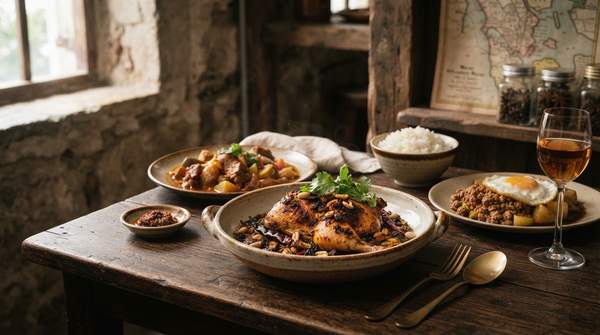
Minchi is perhaps the best-loved example. Marcus describes it as savory minced pork served with rice — a humble dish that pairs a Portuguese-style preparation of minced meat with the Chinese staple of rice, seasoned along the way with the trade-route pantry. It remains one of the most visible traditional Macanese foods in the city today.
Tacho tells the story of celebration. As the Michelin Guide explains, it reworks cozido à portuguesa, the hearty Portuguese boiled stew, into a Macanese dish where chouriço meets lap cheong. African chicken, another signature, carries the spice route in its very name, reflecting the African and Indian influences that traveled through Portuguese networks.
These dishes are not museum pieces. Marcus reports that they are still eaten in many of Macao's homes, and a visitor to the city, in her phrase, "can't throw a proverbial rock without hitting a restaurant" selling minchi, African chicken, egg tarts, and other traditional Macanese foods.
Creole vs. Fusion: Defining Macanese Culinary Identity
So is "fusion" the right label? Manuel Fernandes Rodrigues, writing in the Review of Culture, draws a sharp line. Fusion cuisine, he argues, is "usually referred to as an intentional combination of features from two or more different culinary traditions" — his examples include Indian sushi made with basmati rice and curry, and Thai roast duck mixing Chinese roast duck with red curry. Macanese cuisine, by contrast, consists of "dishes born of a place and time which provide a window into peoples' history."
Rodrigues notes that Macanese iconic dishes are known by their designations in Patois — the local creole language — attesting to their genuine evolution in their place of origin. An evolving cuisine, he writes, is shaped by the agricultural and fishery products particular to its city and region, not assembled from current dishes of different countries.
Jeannie Cho Lee reaches the same conclusion: Macanese cuisine is frequently characterized as a fusion of Portuguese and Chinese, but it is more than a simple mix of flavors from two traditions. More accurately, she writes, it is a Creole food, evolved from its parent cultures over many centuries with its own unique dynamic and identity. Rodrigues frames the open question directly: is Macanese cuisine a set of recipes originating at different times in different ports of call, or has it evolved over centuries of history? His answer leans firmly toward evolution.
Understanding Macanese Cuisine's Enduring Legacy
Recognize Macanese cuisine as a historically significant 'Creole' food tradition, distinct from modern 'fusion', that embodies centuries of cultural exchange. That distinction matters for how you taste it: a plate of minchi or Tacho is not a novelty mash-up but the living record of nearly five centuries of households cooking across three culinary worlds.
The measurable indicator of this legacy is the continued recognition and preservation efforts by cultural institutions and culinary experts for Macanese cuisine's unique heritage — from the Michelin Guide's documentation of its dishes and the restaurants still serving them, to scholarly work like Rodrigues's in the Review of Culture and Macao's broader celebration of its gastronomic identity. As long as families in Macao still cook minchi at home and historians still debate whether to call it fusion or evolution, the cuisine's five-century story keeps being written.