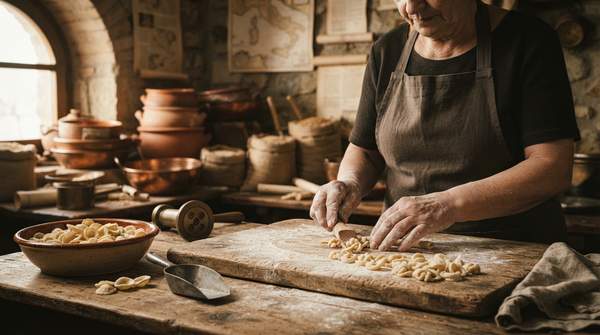
Pasta was not invented in a single moment, and it did not sail into Italy with Marco Polo. The dish we know today took shape over roughly two thousand years, through a chain of separate developments: noodle-like foods in the ancient world, dried pasta carried into Sicily by Arab traders, centuries of refinement across Italy, and finally industrial machinery and emigration that carried it worldwide. Here is that journey, stage by stage.
The Ancient Roots of Noodle-like Foods
Humans have been turning ground grains and water into noodle-like foods for a very long time. The National Pasta Association notes that pasta is believed to have existed in some form in ancient China and Greece, and food historian Gil Marks, writing in the Encyclopedia of Jewish Food, traced noodle-making traditions spreading from China along the Silk Road to Central Asia, reaching Persia by the fourth or fifth century, where they were known as laksha, the Farsi word for "slippery."
Italy's own traceable culinary history reaches back to the Roman Empire, but the editors of America's Test Kitchen caution that pasta's precise origins are difficult to pinpoint. They note that the method of using wheat to make noodles is thought to have reached the Mediterranean from China around the first century, and that lasagna-like noodles appear in southern Italy as early as the fourth century. Etruscan wall paintings from the fourth century B.C. have also been read as depictions of pasta-making equipment, though they show a method of working ground grains with water rather than pasta as we would recognize it today.
One important distinction from Marks: European dough-based recipes were commonly baked or fried, and "strips of dough" were not boiled in water before the medieval period. Whatever ancient peoples were eating, it was not yet the boiled wheat pasta we know.
Debunking the Marco Polo Myth: The True Origins of Italian Pasta
The most persistent story about pasta is also the wrongest one: that Marco Polo brought it back from China in the late thirteenth century. The Accademia Italiana Chef, a Sicilian cooking school, puts it bluntly: "It was not the Chinese, it did not come to us with Marco Polo." Instead, dried pasta was born in Arab-ruled Sicily and then traveled up the Italian peninsula through Naples and Genoa.
The timeline simply does not allow for Polo's involvement. Epicurious's history of pasta describes merchants from the Arab world bringing dried noodles known as itriyah to Sicily by the fifth century—centuries before Polo's voyage. Marks likewise records that noodles reached Sicily and Spain through Arab influence, where they were known as itriya, and spread to mainland Italy sometime after the tenth century. By the time Polo returned from Asia, Sicily had already been producing and exporting dried pasta for generations.