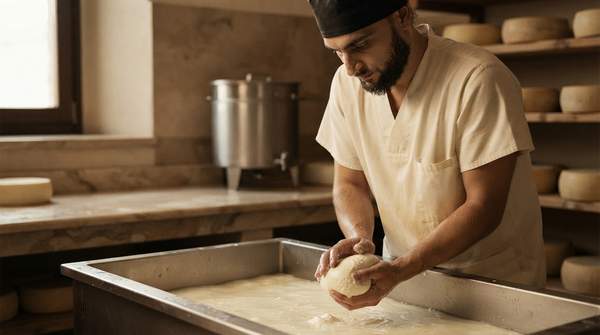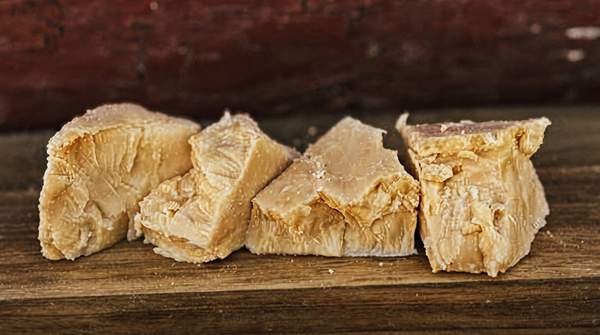
An affineur is the specialist who matures cheese — and affinage is anything but passive storage. As the Academy of Cheese puts it, even a cheese that simply sits in a cave is being actively guided: the affineur decides when to turn, wash, brush, rub and taste, and judges readiness by the final taste, texture and appearance. The craft splits neatly into two domains: controlling the environment (temperature, humidity, aging surfaces) and applying direct physical interventions to the wheel itself. Gruyère AOP, aged on spruce shelves in Swiss cellars, shows both domains working together.
Environmental Control: The Cheese Cave's Influence
The affineur's first tool is not a brush or a cloth but the room itself. Aging happens in caves or cellars where temperature and humidity are deliberately held within narrow bands, because the environment determines how quickly moisture leaves the cheese and how the rind forms. For Gruyère AOP, the product specification calls for maturation cellars kept at roughly 13–14°C with 90–94% humidity — conditions precise enough that the official spec insists any new process or equipment used for ripening must be tested to demonstrate it does not interfere with the product's characteristics.
Humidity matters because a cheese is constantly exchanging with the atmosphere around it. The Gruyère AOP specification is unusually explicit on this point: the rind plays a "fundamental importance" in the exchanges between the cheese and the outside air, and in the making of its taste and aroma, so the making and minding of the rind "must be done with the upmost care." A cave that is too damp invites problems on the surface; too dry, and the wheel loses moisture faster than the affineur wants. The aging surface counts too — Gruyère rests on spruce shelves, which the spec requires to be washed and dried regularly, with excess dampness avoided by using dry cloths and changing shelves. The wood is not incidental equipment; it is part of the controlled environment.